

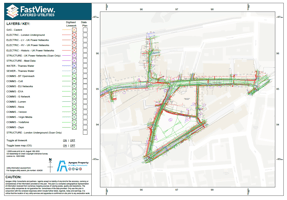
Our Layered PDF for enhancing your Utility Searches is exclusive to CentreMapsLive. With FastView,...
In architecture, efficiency and accuracy aren’t just desirable, they’re essential. Every project demands careful planning, coordination with multiple stakeholders and adherence to technical and regulatory requirements. Utility connections often present a major challenge, particularly when it comes to Point of Connection (PoC) reports. That’s where Apogee, available through CentremapsLive, becomes an indispensable tool for architects and project promoters looking to gain certainty about utility connections (0:30), plan smarter and move faster.
 A PoC report provides a comprehensive overview of how a property or development site can connect to essential services such as electricity, gas, water and telecommunications. Beyond mapping existing utilities, it details the type, capacity and ownership of each connection, identifying supply limits, potential service conflicts and recommended connection points. It also includes information about underground and overhead networks, including depth, materials and protective measures, as well as nearby substations, pumping stations and distribution nodes. The breadth of this insight means the PoC report is valuable to any scheme promoter, including the principal designer, architect, solicitor, Mechanical & Electrical (M&E) engineer, project manager and quantity surveyor (2:29).
The report offers predictive insights, such as estimated installation timelines based on current utility workloads and standard procedures, potential regulatory approvals required and risk factors like easements, environmental restrictions or flood zones. By including geospatial overlays, architects can visualise how multiple services intersect with proposed site layouts, helping to optimise building placement, access routes and service routing.
For early stage planning, the PoC report allows architects to evaluate multiple design scenarios with confidence. The recommendation is often to order the PoC report as early as possible (1:24). This provides an essential picture of not only the risk of utility presence but also the development connectivity. It reduces the need for repeated site visits and utility consultations, providing a single, reliable source of truth.
More than just a planning document, the PoC report can be formally accepted by many planning authorities as a Utility Statement (3:44). It assures the authority that the client has given full consideration to capacity, especially regarding green energy strategies such as EV charging, which are often mandatory requirements for new developments.

Specialist data also supports more complex projects. For example, the report can highlight service redundancy and resilience, important for critical facilities or high-density developments and provide guidance on integrating smart infrastructure, renewable energy or advanced water management systems. It can also indicate whether shared services are feasible for mixed-use developments or whether new connections would require dedicated infrastructure.
For design teams, the report provides a platform for value engineering. Apogee can work with or without a Mechanical and Electrical engineer's specification, either using assumed loadings or the specific loadings provided by the M&E team. This expertise and deep understanding of utility regulations allow the Apogee team to identify significant cost savings. For example, on one relatively modest residential scheme, they helped a client save half a million pounds on the power application alone by strategically splitting the connection and using diversity loading (4:29). Contractors and project managers benefit too: the report’s detailed schematics, technical specifications and connection requirements can directly inform installation planning, material procurement and compliance documentation.
Purchasing an Apogee report through CentremapsLive is straightforward. Simply specify your site and any special requirements; CentremapsLive then coordinates with Apogee to deliver a precise, fully integrated report ready to feed into your project planning tools. You can also order additional datasets, flood and environmental reports, geology data and mapping services simultaneously, making CentremapsLive the ultimate platform for comprehensive site intelligence.
In short, an Apogee PoC report transforms utility planning from a potential bottleneck into a detailed, actionable foundation for smarter design. Whether for residential developments, commercial complexes, historic renovations or sustainable builds, it equips architects with the data and insights needed to move confidently from concept to completion.